
SenseiQ: Real-time earthquake damage insights for safer buildings
30 April 2026
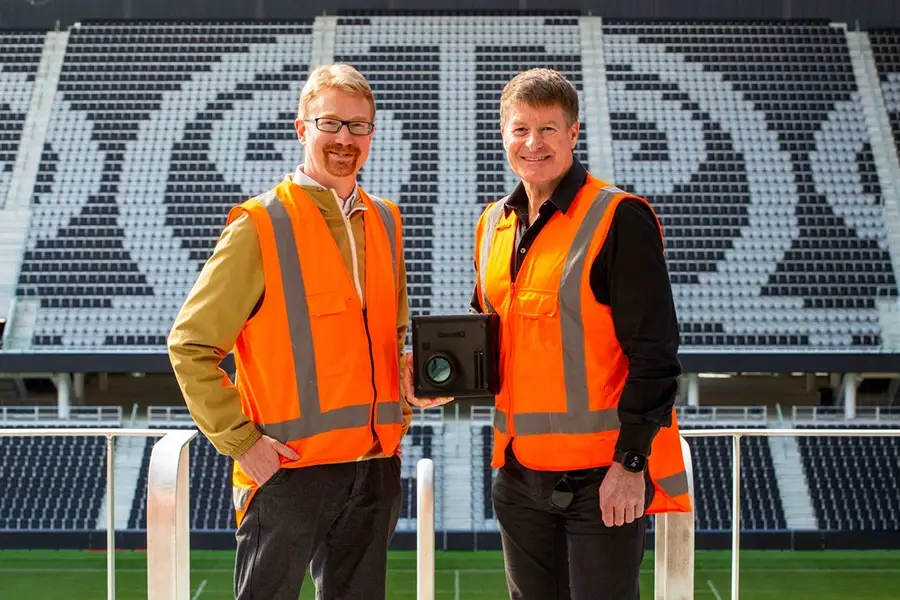
With early backing from KiwiNet’s Emerging Innovator Programme and PreSeed Accelerator Funding, Sense I Solutions has developed a system that delivers fast, reliable data to guide building safety decisions following an earthquake.
When an earthquake strikes, building owners and occupants face an agonising question: is the building safe to re-enter?
Traditionally, the only answer is to evacuate and wait for a structural engineer’s inspection, a time-consuming process that disrupts lives and businesses.
Sense I Solutions, a spin-out from the University of Canterbury (UC), is tackling that challenge.
The company’s revolutionary new technology, SenseiQ, provides immediate, data-driven insights into how much displacement or movement a building has endured during a quake—giving engineers and building owners the information they need to make faster, more confident decisions.
“You can't necessarily tell if a building is unsafe by looking at it,” says co-founder Dr Gabriele Granello, an earthquake engineer who moved to Christchurch in 2015 and witnessed the lingering impact of the city’s devastating quakes.
“Our technology reveals what your building goes through as the earthquake strikes, showing how much it has shifted, and where. This insight helps people get back into their buildings much sooner.”
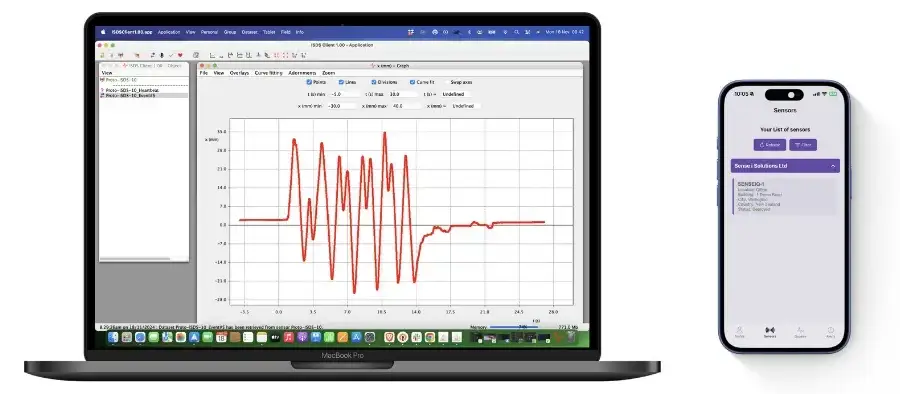
SenseiQ provides precise, real-time data to assess earthquake damage.
From Research to Reality
The idea for SenseiQ took shape in 2019, when Gabriele teamed up with Prof. Roger Nokes and Prof. Daniel Nilsson for a research project at UC’s Civil Engineering department.
Their breakthrough: a compact sensor that measures inter-storey displacement—the relative movement between building floors—in real time during earthquakes. This measurement correlates directly with structural damage, unlike conventional accelerometers that mainly record the shaking intensity.
Supported by UC’s commercialisation team, the researchers began exploring the technology’s market potential. Gabriele credits KiwiNet’s Emerging Innovator Programme with helping him take the leap.
“The Emerging Innovator Programme was amazing—life-changing really,” he says. “It helped open my eyes to the real-world impact of our science and gave me the skills and resources to test its commercial potential.”
Emerging Innovator funding enabled market validation with key stakeholders like structural engineers, building managers, and insurers, confirming there was a market need.

Co-founder Gabriele Granello credits the Emerging Innovator Programme with helping move the technology towards commercialisation.
Gabriele also joined KiwiNet’s Exponential Founders programme, which he says “flipped my mind about how to tell a story and communicate science impact beyond the technical details.”
PreSeed Accelerator Funding, matched internally by UC, then helped the team develop a working prototype.
Spin-out company Sense I Solutions was formed in 2022, with lawyer Andrew Logie—initially advising on legal matters—so intrigued by the project that he joined the founding team.
Path to Market Launch
Four pilot projects in New Zealand, Japan and Taiwan proved the technology and provided key learnings that shaped product development—especially on the software side, where flexibility and integration with other data systems proved essential.
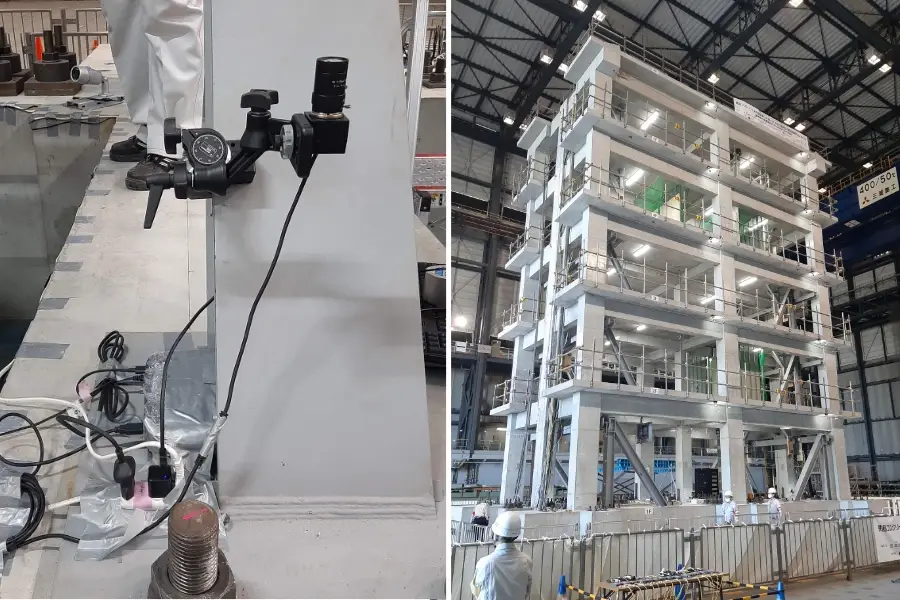
Full-scale testing of SenseiQ technology in Japan
“Pilots taught us that a great product isn’t enough; you need a clear business case and the ability to win people over,” says Gabriele.
“When a research group asked to rent our pilot sensors for their own experiment in Taiwan, that was a huge milestone; it showed the technology had real value to end users.”
That progress is now translating into commercial deployment, with a sensor recently installed at Christchurch’s new One New Zealand Stadium.
“It’s a special moment seeing the technology in such an iconic Christchurch building. Having our sensor used and trusted in a major public venue like the new stadium is incredibly rewarding,” says Gabriele.
The sensor has already recorded a small 2.4 magnitude earthquake at the stadium on 6 April.
The company is now targeting early adopters such as councils, schools and key infrastructure where safety and resilience are critical. Rather than pursuing rapid mass adoption, they are focusing on key customers, pairing the hardware with structural-engineering consultancies to provide a complete service.
The team envisions global potential, but is focused on perfecting the product and business model in New Zealand first.
“It takes resilience to stay the course, but we believe this technology can make a real difference, and that’s what keeps us going,” says Gabriele.
Impact at a glance:
- PreSeed Accelerator Funding supported prototype development
- First commercial deployment at One New Zealand Stadium
- 4 pilot projects completed in New Zealand, Japan and Taiwan
- Enabling faster, data-driven building safety decisions after an earthquake